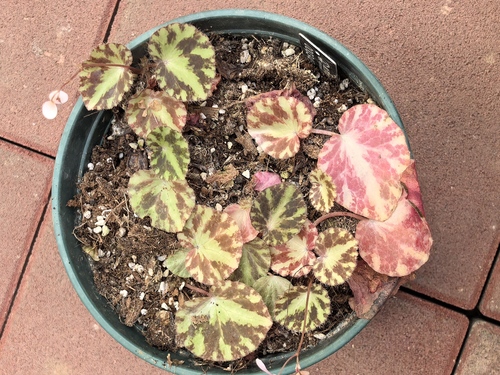
Begonia gironellae, the Bess Begonia, is a rare rosette-forming begonia endemic to northern Palawan in the Philippines, found in lowland seaside forest. It is grown for its variegated, broadly ovate leaves and needs warm, humid, shaded conditions with well-drained soil.
Family
Begoniaceae (Begonia family)
Light
Part shade, Bright indirect
Water
Water when the top of the potting mix begins to dry, keeping it evenly moist but never soggy.
Soil
Light, well-draining, peat-based or begonia-specific mix with added perlite or bark.
Temperature
18–28 °C; protect below 13 °C
How easy
Moderate
Safety
Toxic to cats and dogs (ASPCA).
Native range
Philippines
Climate
wet tropical
About
Begonia gironellae, the Bess Begonia, is an endemic species of Begonia discovered in Tanabag, Puerto Princesa, in northern Palawan, Philippines. The species resembled Begonia cleopatrae, in that both species have widely ovate, variegated leaves, and fleshy hairs fused into a ring at the base of the leaf petiole. However, Begonia gironellae differed from B. cleopatrae due to its rosette habit with rhizome shorter to 5 cm long, with very congested internodes, widely triangular stipules, differently-sized lamina and bracts, and capsule with wider abaxial wing. Additionally, B. gironellae is a lowland species occurring in broadleaved seaside forests, while B. cleopatrae grows on hill forest at ca. 400m.
Text excerpted from the Wikipedia article Begonia gironellae by its contributors, under CC BY-SA 4.0; the excerpts and the care summary drawn from them are shared under the same licence.
The care summary was written by AI (Claude, Anthropic) from the sources on this page, with general growing knowledge where they are silent. Check before relying on it.
Life form, climate and native range: World Checklist of Vascular Plants, Royal Botanic Gardens, Kew (CC BY 3.0), reformatted; see Plants of the World Online.