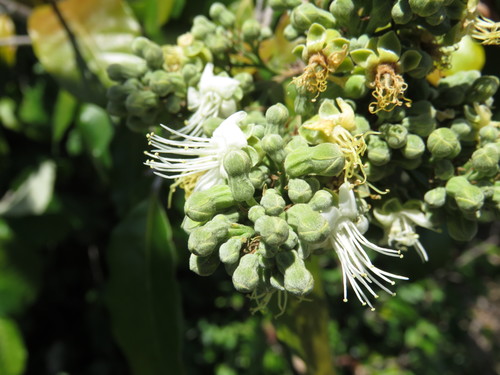
Couepia polyandra is a small evergreen tree from wet tropical Mexico and Central America, grown mainly for its edible wild fruit. It needs warm, humid conditions and a site that stays moist.
Family
Chrysobalanaceae (Chrysobalan family)
Grows as
Tree
Light
Full sun
Water
Keep soil evenly moist during growth; avoid waterlogging.
Soil
Well-drained, fertile loam or sandy loam.
Temperature
20–32 °C; protect below 10 °C.
How easy
Moderate
Edible
Yes, some parts
Native range
Mexico to C. America
Climate
wet tropical
About
Couepia polyandra, also known as olosapo, zapote amarillo, baboon cap, and monkey cap, is a flowering tree in the family Chrysobalanaceae.
Safety
A new triterpene, 3beta,16beta,23-triacetoxyolean-12-en-28-oic acid, was isolated from Couepia polyandra, as well as four known compounds, oleanolic acid, betulinic acid, stigmasterol, and beta-sitosterol. All five compounds inhibited DNA polymerase beta lyase activity.
Where it grows
Couepia polyandra is native to southern Mexico south to Panama and has been introduced to Florida. It grows wild in damp thickets, riverine forests, and low woodland up to 2,000 feet (610 meters) in elevation.
Uses
The fruit is gathered from the wild and eaten and it is occasionally cultivated for its fruit.
Text excerpted from the Wikipedia article Couepia polyandra by its contributors, under CC BY-SA 4.0; the excerpts and the care summary drawn from them are shared under the same licence.
The care summary was written by AI (Claude, Anthropic) from the sources on this page, with general growing knowledge where they are silent. Check before relying on it.
Life form, climate and native range: World Checklist of Vascular Plants, Royal Botanic Gardens, Kew (CC BY 3.0), reformatted; see Plants of the World Online.