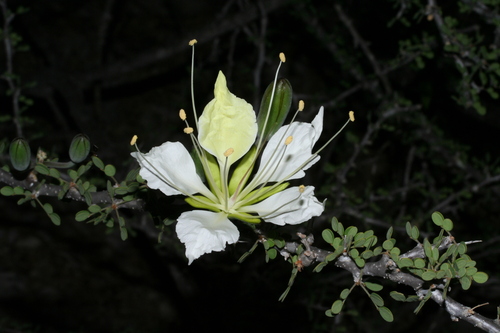
Delonix edulis is a spreading, multi-stemmed shrub from semi-arid southwest Madagascar, grown mainly for its edible seeds (nuts) that are being studied as a possible nut crop. It needs hot, dry conditions, alkaline soil and very little water.
Family
Fabaceae (Pea & bean family)
Grows as
Annual
Light
Full sun
Water
Water sparingly and let the soil dry out fully between waterings; it tolerates drought.
Soil
Well-drained, alkaline soil such as limestone-based or sandy mix.
Temperature
Warm tropical to subtropical conditions; protect from frost.
How easy
Moderate
Edible
Yes, some parts
Native range
Madagascar
Climate
seasonally dry tropical
About
Delonix edulis (Malagasy:Tara) is a species of edible wild plant native to southwest Madagascar. The plant grows in semi-arid tropical zones with annual rainfall less than 400 mm, from sea level up to 100 meters elevation.
The plant is classified in subfamily Caesalpinioideae of family Fabaceae. The scientific synonym Lemuropisum edule means edible lemur's pea.
How to grow it
Not cultivated in Madagascar. In Australia, after soaking the seeds for 10 hours, germination is rapid. Alkaline soils preferred. Nuts (seeds) are harvested from the ground following dehiscence. Nuts eaten raw, discarding the brittle testa, the cotyledons agreeably sweet with a cashew-like flavour, smooth consistency and a flexible, rather plastic texture. Apparently not used in cooking; when eaten green the flavour is reminiscent of fresh garden peas.
Where it grows
Delonix edulis is endemic to coastal southwestern Madagascar, where it has a restricted and fragmented range. Its main population is around Itampolo.
Uses
The nuts contain 38-43% available carbohydrates, 26-32% unavailable carbohydrates, 14-16% protein and 6-9% fat, comparing favourably with those of Cordeauxia edulis. However, the ingestion of 100 g kernels, ca. 84 raw seeds, may inhibit human production of chymotrypsin and cause digestive upsets, although this could possibly be reduced by cooking or roasting the seeds.
Text excerpted from the Wikipedia article Delonix edulis by its contributors, under CC BY-SA 4.0; the excerpts and the care summary drawn from them are shared under the same licence.
The care summary was written by AI (Claude, Anthropic) from the sources on this page, with general growing knowledge where they are silent. Check before relying on it.
Life form, climate and native range: World Checklist of Vascular Plants, Royal Botanic Gardens, Kew (CC BY 3.0), reformatted; see Plants of the World Online.