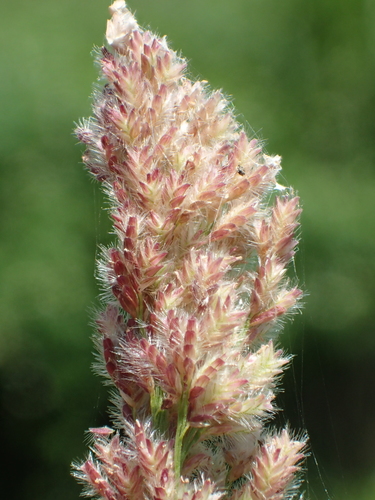
Gophertail lovegrass is a tufted annual or short-lived perennial grass native to the Old World tropics, now widespread in warm regions of the Americas. It thrives in full sun and dry, open ground, and is a weedy pioneer on disturbed land.
Family
Poaceae (Grass family)
Grows as
Grass
Light
Full sun
Water
Drought tolerant once established; water young plants until roots are well developed.
Soil
Sandy, well-drained or poor soils; tolerates a wide range of soil types.
Temperature
20–35 °C; damaged by frost
How easy
Easy
Safety
Not known to be toxic
Edible
Yes, some parts
Native range
Trop. & Subtrop. Old World
Climate
seasonally dry tropical
About
Eragrostis ciliaris, the gophertail lovegrass, is a species of grass (family Poaceae). It is native to the Old World Tropics; nearly all of Africa, Madagascar, other Indian Ocean islands, the Arabian Peninsula, the Indian Subcontinent, Myanmar, Vietnam, Taiwan and the Philippines and a number of Pacific islands, and has been introduced to the New World Tropics and Subtropics, from the southern United States to Argentina, the Caribbean, and other Pacific islands. Its seeds are edible and nutritious, but quite small and difficult to harvest and handle, so it is usually regarded as a famine food.
Text excerpted from the Wikipedia article Eragrostis ciliaris by its contributors, under CC BY-SA 4.0; the excerpts and the care summary drawn from them are shared under the same licence.
The care summary was written by AI (Claude, Anthropic) from the sources on this page, with general growing knowledge where they are silent. Check before relying on it.
Life form, climate and native range: World Checklist of Vascular Plants, Royal Botanic Gardens, Kew (CC BY 3.0), reformatted; see Plants of the World Online.