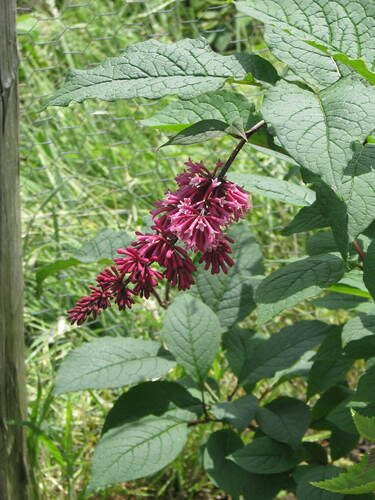
Nodding Lilac is a hardy shrub from central China, growing 3 to 6 m tall, with fragrant pink to mauve early-summer flowers in drooping clusters. It needs full sun and cold winters, and it is grown mainly for its flowers and as a breeding parent for other lilacs.
Family
Oleaceae (Olive family)
Grows as
Shrub
Light
Full sun
Native range
C. China
Climate
temperate
About
Syringa komarowii is a species of lilac native to central China, commonly called nodding lilac. It is native to the Provinces of Gansu, Hubei, Shaanxi, Sichuan, Yunnan.
It is a shrub growing to 3–6 m (9.8–19.7 ft) tall, with erect branches. The leaves are oval-oblong, 5–19 cm (2.0–7.5 in) long and 2–7 cm (0.8–2.8 in) broad. The flowers are fragrant and range in colour from pink to mauve, sometimes with a white base; they are produced in early summer, rather later than most other cultivars, on panicles 4–25 cm (1.6–9.8 in) long and are attractive to bees, butterflies, and birds. The panicles often hang limply, which is how the plant got its common name; the clusters look as though they are nodding.
How to grow it
Like most lilacs, it needs to be planted in full sun. It is able to survive cold winters. The flowers are good for cutting. While this plant is beautiful, it is not commonly used in landscaping. However, it is used for breeding with other species of Syringa.
Text excerpted from the Wikipedia article Syringa komarowii by its contributors, under CC BY-SA 4.0; the excerpts and the care summary drawn from them are shared under the same licence.
The care summary was written by AI (Claude, Anthropic) from the sources on this page, with general growing knowledge where they are silent. Check before relying on it.
Life form, climate and native range: World Checklist of Vascular Plants, Royal Botanic Gardens, Kew (CC BY 3.0), reformatted; see Plants of the World Online.