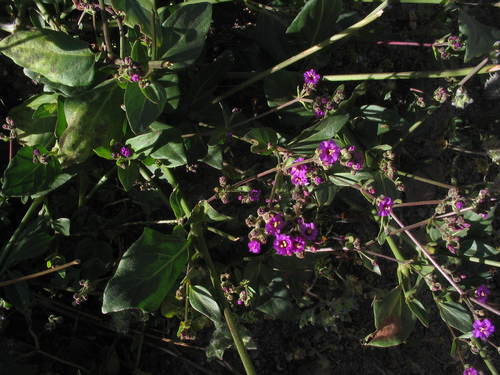
Mauka is a perennial Andean root crop grown for its large, edible storage roots and leaves, and it is a member of the four o'clock family. Its key to success is cold, windy highland conditions with steady rain and slightly acidic to neutral soil.
Family
Nyctaginaceae (Nyctagin family)
Grows as
Perennial
Light
Full sun
Water
Needs about 600 to 800 mm of rain a year; water regularly in dry spells, as a minimum of 500 mm is needed.
Soil
Deep, well-drained soil with a pH of 6 to 7; survives down to pH 5.5.
Temperature
Grows at 2,200 to 3,500 m altitude in cold conditions; the top dies back with frost but the root is hardy.
How easy
Moderate
Safety
Mildly toxic: Raw roots of some forms can irritate the mucous membranes; sun-drying and boiling removes the irritant.
Edible
Yes, some parts
Native range
Peru to Chile (Tarapacá, Valparaíso)
Climate
montane tropical
About
Mirabilis expansa (mauka or chago) is a species of flowering plant in the four o'clock family, Nyctaginaceae. Its roots can reach the size of a man's forearm and the plant can grow 1 metre (3+1⁄2 feet) tall. It is cultivated as a root vegetable in the Andes, at cold, windy altitudes, but has otherwise received little commercial interest.
How to grow it
Mauka can reproduce with seeds or can propagate vegetatively using basal shoots, pieces of stem or suckers. Vegetative propagation is the technique that is used most often. If a plant is reproduces using a basal shoot it can usually be harvested after one year. If a sucker is used then it may be a longer period of time before the plant can be harvested. Mauka is planted into holes in long narrow grooves that are one meter by one meter and must be earthed carefully. In Ecuador, farmers intercrop mauka with maize to optimize soil structure for root development.
Mauka can grow with a minimum of 500 mm (20 in) of rainfall, optimally with an annual rainfall between 600–800 mm (24–31 in). The absolute minimum pH level that mauka can survive with is 5.5, but the optimal level is between 6 and 7. Mauka is usually harvested annually but can be left in the ground for long periods of time. After two years of growth yields increase substantially. Yields can reach 50,000 kg/ha (45,000 lb/acre) given two years maturation time.
Where it grows
Mirabilis expansa was a very important crop to the Inca Empire and was considered lost. The modern cultivation of mauka was first described in a rural community in Bolivia in the 1960s. Fifteen years later it was found in Ecuador and Peru and has seen the largest area of production in those countries. It has been proposed that the reason mauka has survived in three separate locations is because the Incas had a policy of transplanting valuable crops to communities throughout the empire.
Uses
Mirabilis expansa yields a large amount of edible stems and storage roots. The roots of some forms if eaten directly can irritate the mucous membranes, and should be sun-dried and boiled before eating to eliminate the irritating substance. Once the root has been exposed to the sun, the astringent, bitter taste is replaced with sweetness. Bolivian forms are more often irritating than Ecuadorian forms.
Text excerpted from the Wikipedia article Mirabilis expansa by its contributors, under CC BY-SA 4.0; the excerpts and the care summary drawn from them are shared under the same licence.
The care summary was written by AI (Claude, Anthropic) from the sources on this page, with general growing knowledge where they are silent. Check before relying on it.
Life form, climate and native range: World Checklist of Vascular Plants, Royal Botanic Gardens, Kew (CC BY 3.0), reformatted; see Plants of the World Online.