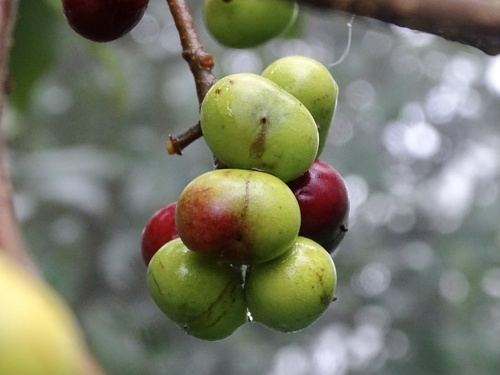
Prunus arborea is a mid-canopy deciduous tree from Asia and Melanesia, growing 7 to 40 m tall with a straight trunk and lightweight golden-brown wood. Most of the information here concerns the wild tree; its cultivation as a garden plant is not described in the sources.
Family
Rosaceae (Rose family)
Grows as
Tree
Light
Full sun, Part shade
Temperature
Wet tropical to subtropical climates; cold tolerance not documented
Safety
Toxic: Seeds and young shoots contain cyanogenic glycosides (amygdalin, prunasin) that release cyanide when ingested, which can be fatal.. Toxic to cats and dogs (ASPCA).
Edible
Yes, some parts
Native range
E. Himalaya to New Guinea
Climate
wet tropical
About
Prunus arborea, most commonly known as xoan đào, is a species of flowering plant in the rose family, Rosaceae. It is distributed throughout Asia and parts of Melanesia.
Where it grows
Prunus arborea is native to a broad geographic range spanning most of Asia, with its distribution extending from the eastern Himalayas to New Guinea. It is specifically documented in the Philippines, including Luzon in Aurora, Mindanao in Bukidnon and Misamis Oriental, and Mindoro, as well as in China, notably within Guangxi, Guangdong, and Hainan. The species is also found across Brunei, Cambodia, Laos, Malaysia, Myanmar, Pakistan, Papua New Guinea, Singapore, Thailand, Timor-Leste, and Vietnam. In Indonesia, the plant is endemic to the islands of Borneo, Java, the Lesser Sunda Islands, Maluku, Sulawesi, and Sumatra. The species is supposedly native to Nepal and Bhutan, but there are currently no confirmed records to substantiate this claim. Prunus arborea has also been introduced to parts of the United States, highlighting its adaptability to diverse tropical and subtropical environments.
Uses
Prunus arborea exhibits both medicinal potential and serious toxicity. The plant, particularly its seeds and young shoots, contains cyanogenic glycosides like amygdalin and prunasin, which release cyanide upon ingestion, making it highly dangerous—posing a fatal risk to humans and animals. Despite its hazards, extracts from the plant have shown medicinal applications such as a phytosterol extract obtained from the plant containing glycine, alanine, and glutamic acid, was evaluated in a clinical study and demonstrated efficacy in treating prostatitis in 94 out of 100 patients without reported side effects. A decoction of leaves has been traditionally used to precipitate childbirth, though pharmacological data on this use remains scarce. Additionally, studies on its leaf essential oil have identified dominant constituents such as benzoic acid, α-methoxy toluene/benzyl alcohol, and (E,E)-α-farnesene/benzaldehyde.
Text excerpted from the Wikipedia article Prunus arborea by its contributors, under CC BY-SA 4.0; the excerpts and the care summary drawn from them are shared under the same licence.
The care summary was written by AI (Claude, Anthropic) from the sources on this page, with general growing knowledge where they are silent. Check before relying on it.
Life form, climate and native range: World Checklist of Vascular Plants, Royal Botanic Gardens, Kew (CC BY 3.0), reformatted; see Plants of the World Online.